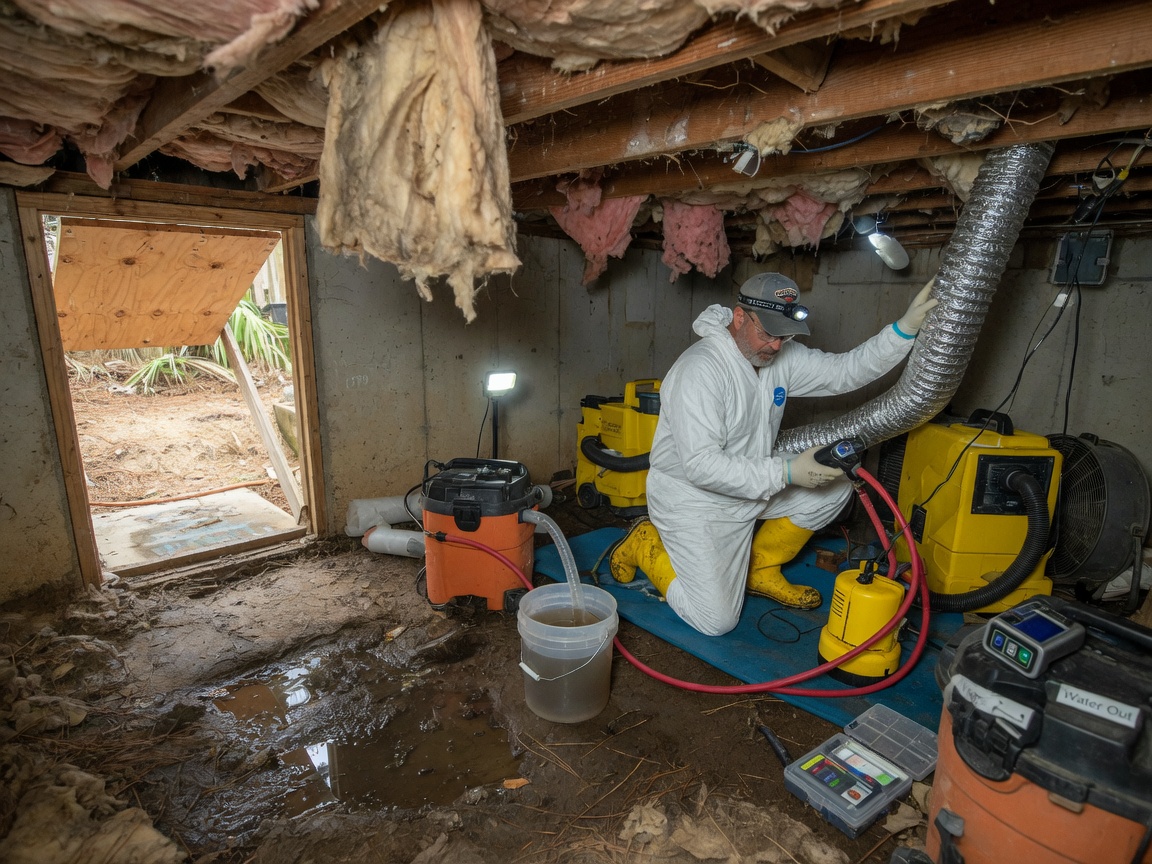
Crawl spaces in Pensacola homes often sit directly on sandy soil with high water tables common in Escambia County. When flooding or plumbing leaks occur, water pools against joists and pier footings, quickly saturating insulation and promoting mold growth in the area's humid subtropical climate. Technicians remove standing water with submersible pumps, then extract trapped moisture from soil and wood using commercial air movers and dehumidifiers sized for the confined space. Vapor barriers must be inspected and often replaced because torn or missing plastic allows ground moisture to rise continuously. Florida building codes require proper ventilation and moisture barriers in crawl spaces, and skipping these steps can lead to failed inspections during resale.
Older neighborhoods such as North Hill and East Hill contain many pier-and-beam homes where narrow access points and low clearance complicate equipment placement. Technicians use moisture meters on sill plates and rim joists to map hidden saturation that surface inspection misses. In cases of sewage intrusion or long-term leaks, affected insulation is bagged and removed to prevent cross-contamination into living areas above. Reinstallation uses closed-cell foam or fiberglass rated for high-humidity environments rather than standard batts that hold water. Homeowners near Pensacola Beach or Naval Air Station Pensacola frequently request these services after storm surges push saltwater into crawl spaces, requiring additional corrosion treatment on metal fasteners.
Proper documentation of moisture levels before and after drying protects against insurance disputes and future claims. Crews also check for wood rot on girders and recommend structural repairs when decay exceeds 10 percent of cross-section. In Cordova Park and Scenic Heights properties, tree roots and poor grading often direct rainwater under the foundation, so restoration includes grading corrections and French drain recommendations. Final verification uses pinless meters and thermal imaging to confirm equilibrium moisture content before closing the space. This process typically requires two to four days depending on saturation depth and ventilation access.
Crawl Space Water Damage Restoration Services We Offer
✓Crawl Space Water Extraction
Removes standing water and saturated soil from beneath the home using pumps and vacuums sized for tight access. Customers need this after storms, pipe bursts, or flooding to prevent immediate structural and mold risks.
✓Crawl Space Drying and Dehumidification
Deploys commercial air movers and low-grain dehumidifiers to bring wood and soil moisture back to safe levels. Required when humidity lingers after initial extraction in Pensacola's climate.
✓Vapor Barrier Installation
Replaces torn or missing plastic sheeting with sealed, heavy-duty barriers that block ground moisture. Homeowners request this after water events or during routine inspections to meet local code standards.
✓Crawl Space Insulation Replacement
Removes water-damaged insulation and installs new material rated for high-humidity environments. Necessary when existing batts hold moisture against joists and promote hidden mold.
✓Crawl Space Mold Remediation
Treats visible and hidden mold growth on wood and soil surfaces following water intrusion. Performed when moisture readings exceed safe thresholds and must be completed before new barriers are installed.
Crawl Space Water Damage Restoration Cost in Pensacola, FL
| Service | Typical Range | What Affects It |
|---|---|---|
| Initial crawl space inspection | $150–$300 | Includes moisture readings and written report; waived if restoration proceeds |
| Water extraction and drying | $800–$2,200 | Varies with square footage and days of equipment runtime |
| Vapor barrier replacement | $1.25–$2.50 per sq ft | Includes sealing to foundation and new material |
| Insulation removal and replacement | $1.50–$3.00 per sq ft | Depends on material type and access difficulty |
Ranges are typical for Pensacola, FL and confirmed with an exact written quote before any work starts.
How it works
- 1
Site Assessment
Technicians enter the crawl space to measure moisture levels, identify water sources, and document damage to joists, insulation, and vapor barriers.
- 2
Water Removal
Pumps and extraction equipment clear standing water and pull moisture from soil while protecting surrounding areas from cross-contamination.
- 3
Drying And Treatment
Air movers and dehumidifiers run until equilibrium moisture content is reached, followed by antimicrobial application where mold risk exists.
- 4
Barrier And Insulation Work
Damaged materials are replaced, new vapor barriers are sealed to foundation walls, and final moisture verification confirms the space is dry.
Pricing
Cost depends on crawl space size, water volume, and whether mold or structural repairs are required.